
West Chester, PA Brisbane, QLD
No treatment plan can outrun a deteriorating source-water trajectory.
Every plan makes assumptions about source water: how much will arrive at the intake, what it will contain, how variable it will be, that it will remain treatable over the life of the asset.

Every plan makes assumptions about source water: how much will arrive at the intake, what it will contain, how variable it will be, that it will remain treatable over the life of the asset.
Those assumptions are rarely treated as primary planning risks even though they determine chemical demand, process complexity, operational resilience, public confidence, and the cost of safe drinking water.
How can we plan treatment infrastructure for 2050 if we do not know what biological and chemical condition the source water will be in by 2050—especially when progressive eutrophication, hypoxia, and toxic cyanobacteria dominance are already recognized as major global threats to water security?
This is a capital-planning, treatment-risk, regulatory, and public-confidence question. AWWA’s Beyond the Replacement Era report recognizes the emerging liability of hard-to-treat water without being able to fully price it.[1]
Article 1 explained why this risk exists: built infrastructure depends on natural infrastructure that it can also overload. The planning blind spot is that the deteriorating condition of that natural infrastructure still sits outside the capital plans of the assets that depend on it.
Water availability alone does not guarantee a secure supply. The decisive question is whether that water remains treatable at reasonable cost, with manageable operational complexity, and without creating unacceptable secondary risks.
Treatment plants receive Biological Water shaped by catchment activity, return flows, nutrients, temperature, organic matter, algae, cyanobacteria, oxygen dynamics, sediment chemistry, runoff, and seasonal variability. These conditions determine chemical demand, filter performance, sludge production, toxin risk, disinfectant requirements, and disinfection-by-product risk.
Treatability does not begin inside the treatment works. It begins upstream, in the biological and chemical condition of the source water.
A plant may be designed around today’s raw-water assumptions while its source water is quietly moving away from them. It may comply today even as the planning basis for tomorrow weakens.
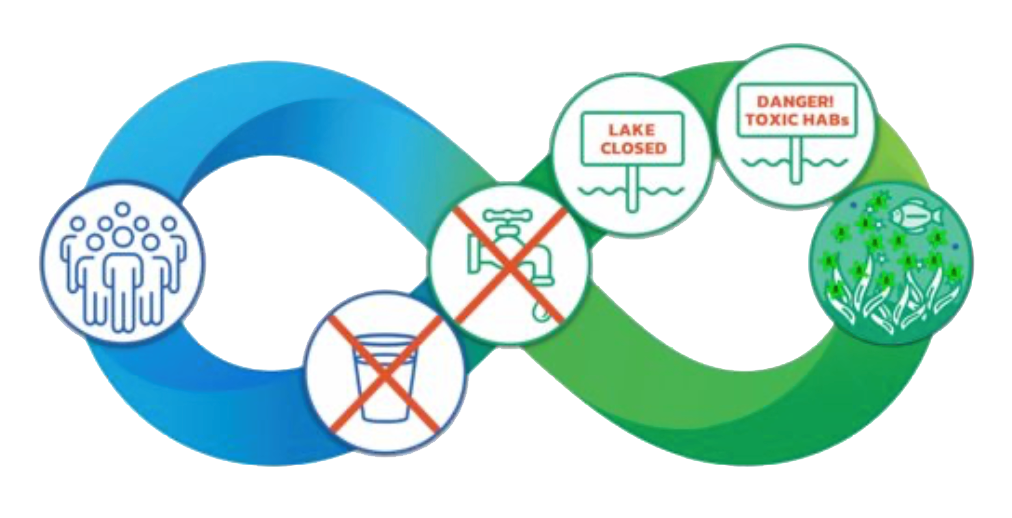
Where source-water decline outpaces the capital-planning cycle, utilities will spend more to remain compliant while the treatment envelope narrows. The asset may appear sound until it meets a raw-water condition it was never designed to manage.
The Johari Window is useful because source-water risks fall into different categories of knowledge, each requiring a different response.
The most consequential category is often not the unknown unknown, but the unknown known: information held somewhere in the system but not integrated into planning.[5]
|
Johari Window category
|
Source-water planning meaning
|
Management response
|
|---|---|---|
|
Known Knowns
OPEN
|
These are conditions already visible in the data and operational experience: raw-water quality trends, treatment performance, seasonal variability, nutrient concentrations, organic load, taste-and-odour episodes, algal counts, cyanobacteria alerts, chemical dose, filter run times, residuals, and compliance history.
|
Manage them deliberately. These conditions should be built into treatment assumptions, capital planning, operating procedures, source-water protection, and performance dashboards.
|
|
Known Unknowns
HIDDEN
|
These are uncertainties the utility can name but cannot predict precisely: future rainfall patterns, drought severity, heat events, runoff pulses, the progress of eutrophication, bloom timing and intensity, regulatory change, contaminant emergence, land-use change, and the future condition of the catchment.
|
Plan for them through scenarios, stress testing, early-warning monitoring, proactive prevention, adaptive design, and source-water resilience measures.
|
|
Unknown Knowns
BLIND SPOTS
|
These are risks already visible in parts of the system but not yet integrated into planning: the degree and speed of eutrophication, weak monitoring, uncertain future trajectory, prevalence of hypoxia, progression toward HAB events, and rising cyanotoxin risk, the effects of chronic toxin exposure and consequent liability.
|
Recover and integrate them. As the GAO has highlighted, HAB and cyanotoxin risks are known, but monitoring, forecasting, prevention, and coordinated response remain underdeveloped. These risks must be brought into capital planning, source-water management, and treatment-resilience decisions.
|
|
Unknown Unknowns
UNKNOWNS
|
These are risks not yet recognised, measured, or institutionally understood: emerging biological shifts, unexpected toxin events, new contaminant interactions, threshold changes in reservoir behaviour, or combinations of climate, nutrient, wastewater, and treatment pressures that have not previously occurred together.
|
Build humility into the plan. Monitoring, biological intelligence, flexible treatment strategy, and source-water restoration reduce the chance that surprise becomes crisis.
|
The water system does not fail only when it lacks information. It also fails when information is trapped in the wrong professional silo or treated as someone else’s problem.
Operators see changing chemical dose, solids loading, filtration, and operational risk. Limnologists see nutrient loading, stratification, oxygen depletion, and internal recycling. Catchment managers see the effects of land use and return flows. Regulators see that compliance does not guarantee long-term resilience. Yet those observations are rarely assembled into a single source-water planning risk.
A future treatment problem may already be visible to operators, scientists, or communities, but absent from the capital plan. The risk is not always the absence of information; it is the failure to convert scattered information into institutional foresight.
A planning blind spot can be understandable when evidence is fragmented and no adequate framework exists to turn knowledge into a managed risk. It ceases to be understandable once the trajectory is documented, the consequences are visible, yet the same information remains outside capital planning. At that point, a blind spot becomes a dangerous decision to turn a blind eye.
The task is to convert known risk into coherent institutional foresight and effective risk management before treatment plants are forced to solve problems that should have been managed upstream.
Eutrophication, hypoxia, organic loading, harmful algal blooms, and cyanotoxins are already part of the operating environment for many water bodies. GAO identifies hypoxia and harmful algal blooms as persistent environmental, economic, and public-health risks, with gaps in prevention, monitoring, forecasting, freshwater attention, and program implementation.[3]
The question is not whether these risks are known. It is whether they are managed with the same seriousness as asset failure, supply reliability, demand growth, and regulatory compliance.
As eutrophication progresses, treatment becomes more dynamic and less predictable. Algae raise organic load; cyanobacteria raise toxin risk; oxygen depletion accelerates nutrient release from sediments; and organic carbon increases disinfectant demand and disinfection-by-product risk. These changes can outpace conventional planning and tactical plant operation.
A utility can respond to many of these conditions tactically. But if source-water trajectory continues to deteriorate, a reactive treatment-only response becomes more expensive, disruptive, and less effective.
The deeper risk is not simply that a bloom may occur. It is that source-water condition changes faster than treatment assumptions, funding cycles, and regulation can adapt.
No utility can predict the exact rainfall, heat, drought, storm, runoff, hypoxia, or bloom conditions it will face in 2050. Professional risk management does not require perfect prediction; it requires reducing exposure to a direction of risk that is already clear.
Weather volatility affects runoff, nutrient loading, reservoir mixing, temperature, oxygen depletion, drought concentration, toxin production, and treatment reliability. AWWA and GAO both point to the growing challenge of planning under uncertainty and vulnerability.[2] [4]
Climate is a source-water risk amplifier. A more stable reservoir gives a treatment plant a more stable input; stronger biological function makes a water body less likely to convert every storm, heat period, or low-flow event into a treatment shock.
Modern treatment engineering protects public health every day. Nothing in this argument diminishes its importance.
As source water becomes more biologically degraded, treatment plants require more chemicals, process stages, monitoring, solids handling, energy, operator sensitivity, and capital. Those responses also bring higher residuals, costs, disinfection-by-product exposure, and compliance complexity.
A treatment plant can be upgraded, but if the raw-water baseline continues to deteriorate, the target keeps moving. The utility spends more to remain compliant while source water becomes less stable and less forgiving.
That is not resilience. It is an escalating treatment burden.
Professional risk management looks beyond current performance to exposure, sensitivity, thresholds, feedback loops, hidden dependencies, and early-warning indicators.
For drinking water, that means planning for source-water trajectory as well as treatment capacity, asset condition, financing, emergency response, and compliance.
The planning boundary should move upstream in three practical ways:
|
Planning shift
|
Professional implication
|
|---|---|
|
From raw water as an input to raw water as a managed risk.
|
Management of source-water condition becomes part of treatment planning and operations, not only observation and environmental monitoring.
|
|
From reactive episodic incident response to proactive trajectory management, prevention and remediation.
|
Utilities and catchment partners track leading indicators of whether the water body is becoming more or less treatable over time.
|
|
From current compliance confidence to future resilience confidence.
|
Current standards are supplemented by evidence that the source-water system remains within a stable treatment envelope.
|
Utilities cannot solve every catchment problem alone. But utilities, regulators, catchment authorities, wastewater managers, land-use planners, and environmental agencies need a shared risk language. If degraded source water will raise future treatment burden, it belongs inside the water-security plan.
The traditional question is, “How do we treat this water?” The better question is, “How do we keep this source water in a condition that makes current and future treatment reliable, affordable, and publicly acceptable?”
The 2050 question remains the right one:
How can we plan treatment infrastructure for the next generation if source-water condition remains outside the plan?
The answer is to stop treating source-water condition as an external uncertainty and start treating it as a central planning variable.
Much of the risk is already in the reservoir—and may not be unknown at all. It may be knowledge held by operators, scientists, and catchment managers, or revealed through better biological monitoring, but not yet integrated into infrastructure planning. The task is to act on what is already known before future treatment plants are forced to solve problems that should have been managed upstream.
If source-water condition is a planning risk, reuse strategies must meet a more demanding test: not simply whether water can be used again, but whether it can be repeatedly renewed for potable production without accumulating the debt that makes each future treatment cycle harder, more expensive, and less reliable. That is the question the next article addresses.
Water reuse is a necessary response to scarcity. It is not, by itself, a water-security strategy. Reuse simply asks whether water can serve another beneficial purpose. Water security asks whether the managed cycle can repeatedly restore water for safe, reliable, affordable potable production.

Join us. The future of water is biological.
© Sustainable Infrastructure Solutions