Specific pH and redox conditions support temporary inactivation.

West Chester, PA Brisbane, QLD
Symptom suppression is not restoration when it deepens biological debt.
Cosmetic Improvement Makes Eutrophication Harder to Reverse

Cosmetic Improvement Makes Eutrophication Harder to Reverse
Many interventions used against eutrophication produce a visible result. Algaecides kill algae. Herbicides kill weeds. Aeration raises average dissolved oxygen. Phosphorus precipitants bind phosphorus. Dredging removes sediment.
The question is not whether these treatments can change a selected metric or improve a water body’s appearance. It is whether they restore the biological function that prevents eutrophication from recurring.
The Paradox of Symptomatic Treatments arises when an intervention suppresses a visible symptom while leaving the mechanisms driving eutrophication intact – or deepening the biological debt that sustains them.
The lake may look better for a time, but internal nutrient recycling, oxygen depletion, organic sediment accumulation, and the conditions that favor toxic cyanobacteria continue to worsen.
208 PUBLICATIONS · 78 RESTORATION MEASURES
FutureLakes Innovation in Lake Restoration: Literature Review1
The treatments examined below reveal different dimensions of the same paradox.
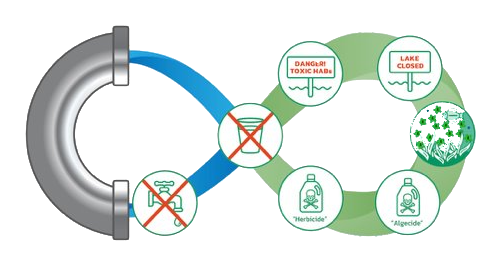
When success is measured by temporary symptom suppression rather than biological recovery, treatments will be repeated more often, costs will rise, and each apparent improvement may leave the water body with more organic sediment, greater oxygen demand, and less capacity to renew itself. The surface can look better while the system becomes harder to restore.
Aeration, including hypolimnetic aeration, nanobubbles, and physical mixing, is widely used to mitigate hypoxia and internal phosphorus loading. In some systems it may provide useful short-term oxygen support. It is not, however, the same as sustained biological restoration at the sediment-water interface.
Lake Carmi in Vermont illustrates why the distinction matters.
LAKE CARMI, VERMONT
Intermittent averages suggested improvement. Continuous benthic monitoring revealed a different biological reality.
mg/L average bottom dissolved oxygen during July–September
higher phosphorus near sediment than grab samples indicated
mg/L per day oxygen-depletion rate with aeration
Kirol et al. (2024) studied a four-year whole-lake aeration program at Lake Carmi. Average bottom dissolved oxygen appeared to improve from 0.77 mg/L to 3.96 mg/L during July–September, based on intermittent sampling at 8 meters.[2]
But deeper continuous sensors 0.5 meters above the sediment-water interface revealed a different biological reality. During stratified conditions, total phosphorus near the sediment was on average 1.7 times higher than grab samples indicated, showing that intermittent measurements underrepresented the most consequential events.[2]
The continuous record also showed repeated wind-driven mixing events, oxygen spikes and crashes, and an oxygen-depletion rate that rose from 0.37 mg/L per day without aeration to as high as 1.3 mg/L per day with it.[2]
Temporary aerobic conditions stimulated biological activity faster than the system could sustain them. Summer phosphorus concentrations were higher during aeration years than before aeration; internal loading was not suppressed but shifted into repeated summer pulses.[2]
The system met a theoretical oxygen-supply objective but failed to account adequately for the biological oxygen-demand dynamics at the benthic margin. [See the detailed Lake Carmi case study.]
The Lake Carmi mechanism is clear: aeration without sufficient, sustained dissolved-oxygen delivery at the benthic margin can stimulate activity faster than it can support it. The result is repeated microbial blooms and crashes, additional dead organic matter in the sediment, and a deeper oxygen debt. A better average dissolved-oxygen statistic can be technically accurate yet biologically misleading.
At Lake Carmi, the aeration system caused toxic cyanobacteria blooms to increase in intensity and frequency. The project was abandoned, removed, and scrapped in 2024.
 Algaecides – chemical, ultrasonic, or nanobubble-based – are intended to kill algae. Their delivery mechanisms differ, but every algaecide creates the same fundamental biological problem: it kills nutrient-rich biomass without ensuring that the resulting organic load can be processed aerobically.
Dead algae sink and decompose. Their organic load is transferred to sediment, where their decomposition consumes oxygen and recycles the phosphorus and nitrogen that algae had temporarily sequestered. A visible surface bloom becomes a benthic fuel source for the next one.
VISIBLE SYMPTOM
VISIBLE SYMPTOM
Cyanobacterial cells are nutrient-dense. Suppressing a bloom deposits a substantial nutrient pulse onto sediment that is often already oxygen-stressed and releasing phosphorus. The result is greater internal loading and a water body that is biologically worse than before treatment.
GAO identifies algaecides as common reactive response tools in the management of harmful algal blooms and calls for stronger prevention, monitoring, forecasting, and risk management.[4] Algaecide use embodies the reactive model: it is deployed at the point of maximum visible crisis and transfers the problem into the sediment where it compounds the underlying condition.
No delivery mechanism removes that paradox. Algaecide kills biomass and adds it to an already-overloaded sediment system that cannot process it aerobically.
Aquatic herbicides target nuisance macrophytes rather than algae, but the same biological consequence follows. Every herbicide kills biomass that would otherwise remain part of a living system and transfers it into decomposing organic material that consumes oxygen and recycles nutrients.
Woodward et al. (2024) found that diquat-treated Lagarosiphon major released its largest pulses of total nitrogen and phosphorus immediately after treatment through cell lysis – before the plants showed visible decay.[3] By the time a manager sees a dead weed bed, a significant nutrient-loading event has already occurred.
The target organism differs, but the paradox does not: kill biomass, transfer it to oxygen-stressed sediment, deplete oxygen through decomposition, and recycle nutrients into the water column.
Internal phosphorus loading can sustain blooms long after external nutrient inputs have been reduced. Phosphorus precipitants – principally aluminum sulfate and lanthanum-modified clay products – attempt to bind immediately available dissolved phosphorus in the water column and at the sediment surface.
Every phosphorus-inactivation treatment makes a water body biologically worse when it substitutes chemical binding for biological recovery. It treats phosphorus as an isolated target while leaving the hypoxia, organic sediment accumulation, microbial dysfunction, and food-web collapse that sustain its release untouched.
WHEN CONDITIONS HOLD
Specific pH and redox conditions support temporary inactivation.
WHEN HYPOXIA RETURNS
Anaerobic sediment conditions enable phosphorus release and repeat treatment.
Alum and lanthanum-modified clay bind phosphorus only under particular chemical conditions, especially pH and redox state. When sediments remain or return to anaerobic conditions, binding capacity is compromised and phosphorus is released again. In the absence of sustained biological recovery, repeat application becomes inevitable.
FutureLakes reports major variability in phosphorus-inactivation outcomes. That variability is explained by the biological condition of the sediment: the same chemical response cannot produce durable recovery where the hypoxia and organic loading that drive internal phosphorus release continue.[1]
Mechanical dredging removes nutrient-enriched sediment and, in some water bodies, may be necessary. It is not, on its own, a biological restoration strategy.
Dredging removes the accumulated consequence of eutrophication without changing the processes that produced it. If primary production, organic-matter decomposition, and the balance between aerobic and anaerobic conditions remain unchanged, nutrient-enriched sediment will re-accumulate.
Dredging can therefore be a legitimate component of a recovery program, but it cannot be the program. Removing sediment without restoring the biology that prevents re-accumulation is like draining a flooded basement without fixing the broken pipe.
In Gauteng, the issue is not abstract. The South African Human Rights Commission reported pollution of the Hennops River, Roodeplaat Dam, and other freshwater bodies by untreated and partially treated sewage and sludge; wider research has warned that eutrophication and cyanotoxin risk threaten the usability of freshwater resources across the country.[13] [14]
Indirect potable reuse becomes water security only when the receiving water body is managed as water-renewal infrastructure. Discharging treated wastewater into a river or dam does not create a secure reuse system if that water body is becoming eutrophic, toxic, oxygen-stressed, or microbiologically unsafe.
The treatments reveal a clear hierarchy. Algaecides, herbicides, and phosphorus inactivation make water bodies biologically worse because they kill biomass or chemically mask nutrient availability while leaving the disease mechanisms intact. Aeration may mitigate hypoxia in some circumstances, and dredging may sometimes be needed, but neither restores a water body unless it is part of a broader biological recovery pathway.
FutureLakes’ conclusion applies: “Restoration efforts that mainly treat the symptoms of eutrophication often need to be repeated regularly, as they do not address the underlying causes.”[1] The paradox is foreseeable, not a discovery made in hindsight. Killing biomass, adding intermittent oxygen, binding phosphorus in anaerobic sediment, or removing sediment without restoring the processes that prevent re-accumulation will not be biologically neutral. It is intervention in a living system without adequate biological understanding.
It is the consequence of treating the syndrome’s shadow rather than the syndrome.
Projects serving parks, industry, construction, cooling, and landscaping can be worthwhile. But they do not resolve the core problem if the reservoir supplying drinking water is becoming more eutrophic, cyanobacteria-prone, variable, or costly to treat.
Renewable Water changes the trajectory by asking whether the managed cycle is restoring the conditions required for repeated potable production.
It means treating rivers, lakes, dams, and aquatic food webs as water-security infrastructure – not scenery around it.
Regions still building their water systems can avoid the old pattern of use, discharge, degradation, and escalating treatment. They can manage built and natural infrastructure together from the start.
A non-paradoxical intervention must address the biological mechanisms that sustain eutrophication at the sediment-water interface; restore aerobic conditions that can be maintained; reduce legacy nutrient recycling; support food-web recovery; and demonstrate verifiable improvement in biological condition rather than temporary improvement in appearance.
This is not a preference for one technology over another. It is the minimum standard any credible intervention should meet. FutureLakes’ conclusion remains the appropriate test: systemic biological problems require approaches that address their causes.[1]
The practical implication is clear: a solution should be assessed against whether it restores the conditions that allow a water body to renew itself – not merely against whether it produces a favorable short-term metric.
A symptomatic treatment may have a legitimate palliative role when the immediate task is to manage a crisis. But palliative care is not rehabilitation. If the objective is to restore a water body’s ability to renew water, an intervention must strengthen the biological function that makes recovery possible – not merely make decline less visible.
The lesson is not that intervention is futile. It is that a biological water-security problem cannot be solved by treatments that merely suppress the evidence of biological failure.
PALLIATIVE ROLE
Manage an immediate crisis and make decline less visible.
RESTORATIVE ROLE
Strengthen the biological function that makes recovery possible.
If water bodies are to renew water rather than accumulate debt, they must be diagnosed, managed, and restored as living systems. The question is no longer whether biology matters. It is where the applied biological capability needed to do this work has been—and why it is still absent from the mainstream water-security toolkit.
That is the subject of the next article.
The first four articles in this series establish a chain of logic. Built infrastructure depends on natural infrastructure. Source-water decline is a planning risk that can no longer be ignored. Water is secure only when it can be repeatedly renewed for potable production. And symptom-focused treatments have failed because they suppress visible effects while leaving – or deepening – the biological mechanisms of decline.

Join us. The future of water is biological.
© Sustainable Infrastructure Solutions