
West Chester, PA Brisbane, QLD
Built infrastructure is only as secure as the natural infrastructure that supplies it.
When the Systems Built to Manage Water Begin to Overwhelm the Systems That Renew It
When the Systems Built to Manage Water Begin to Overwhelm the Systems That Renew It
Water infrastructure is one of the great public-health achievements of the modern era. Dams, reservoirs, treatment works, sewers, pumps, pipes, monitoring systems, and distribution networks made cities, economies, and public health possible at scale. But that achievement now has a second-order problem.
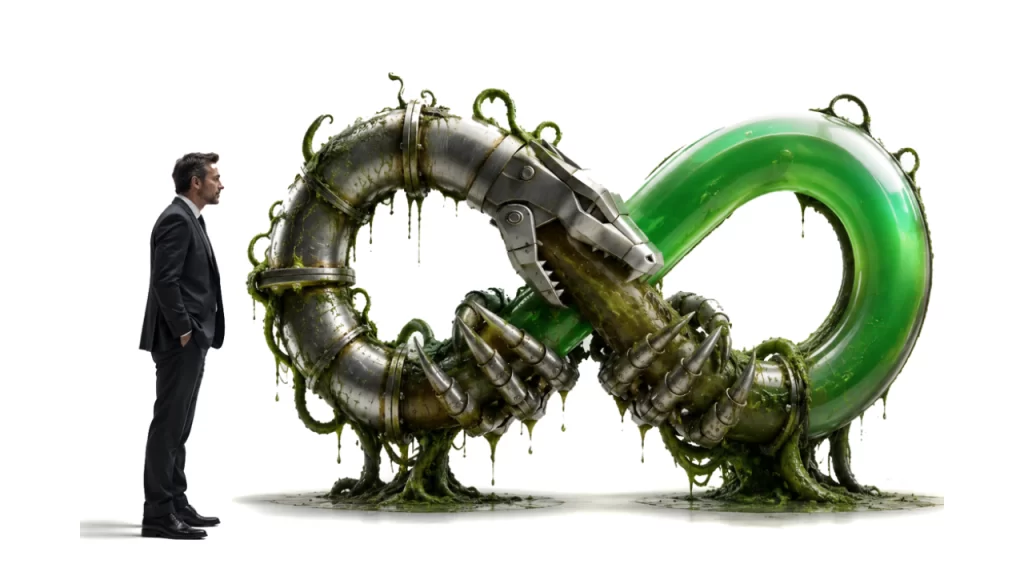
This is the Paradox of Infrastructure. As built infrastructure expands, it can overwhelm the natural systems that supply and renew the water on which it depends. When natural renewal capacity declines, built infrastructure becomes more exposed, more expensive to operate, and more dependent on complex treatment processes. This is a planning, regulatory, operational, and capital-investment issue.
The systems built to store, move, treat, collect, and discharge water depend on another system that has received far less attention: the natural infrastructure made up of water bodies that receive waste return flows, process residual loads, restore water quality, and make future water use possible. Lakes, reservoirs, rivers, wetlands, microbial communities, algae, plants, and food webs are not scenery around the water system. They are the natural infrastructure that makes the engineered water system viable.
The modern water model follows a practical sequence: abstract, treat, distribute, use, collect, treat again, and discharge. It has served society well, but it carries an implicit assumption: once water leaves the engineered system, nature will complete the renewal work.
Wastewater treatment reduces pollutant concentrations; it does not make residual loads disappear. A facility may comply at its discharge point but the receiving water body absorbs the cumulative effects of multiple discharges, stormwater, agricultural runoff, septic leakage, sediment release, and climate variability.
A permit can regulate a point concentration. It cannot, by itself, determine whether a lake, river, or reservoir can continue processing the combined loads without losing renewal capacity.
EPA identifies excess nitrogen and phosphorus as major causes of water-quality impairment, while GAO has warned that hypoxia and harmful algal blooms remain persistent environmental, economic, and health risks.[1] [2] These are early warnings that receiving waters may no longer be processing loads within a stable renewal envelope.
The infrastructure paradox begins when treatment compliance is mistaken for ecological compatibility.
Compliance is necessary, measurable, auditable, and enforceable. It is not, however, a complete measure of systemic impact or resilience.
A treatment plant can meet its permit while contributing to deterioration of the receiving water body. Each discharge may be acceptable in isolation while the cumulative load exceeds what the water body and its biological community can process. The engineering answer may be “yes” at each facility while the biological answer across the system has become “no.”
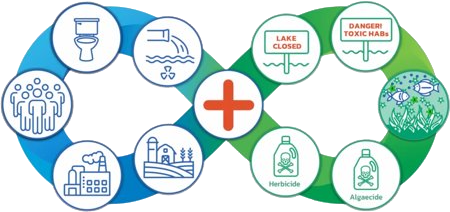
When compliance at individual facilities is treated as proof of system resilience, cumulative biological risk will build in receiving and source waters. Treatment burden, operational volatility, and exposure to hard-to-treat water will rise - even while every individual asset appears compliant.
Natural infrastructure should be understood as the living and physical systems that perform work essential to water security: nutrient transformation and clearance, sediment interaction, oxygen regulation, microbial processing, food-web transfer, retention, and ecological stabilization.
These processes determine whether a water body remains oxygenated, biologically balanced, treatable, and usable. They also shape taste-and-odor risk, algal composition, cyanotoxin risk, and the complexity and cost of downstream treatment.
|
Built infrastructure asks
|
Natural infrastructure answers
|
|---|---|
|
Can we collect and treat the wastewater?
|
Can the receiving water process the combined cumulative residual load it receives?
|
|
Can we meet the discharge standard?
|
Is the downstream natural water infrastructure accumulating biological debt?
|
|
Can we expand treatment capacity for growth?
|
Can we expand treatment capacity for growth?
|
|
Can we treat today’s raw water?
|
Will tomorrow’s source water remain treatable and affordable?
|
Natural infrastructure has processing limits. When nutrient inputs exceed nutrient-clearance capacity, water bodies shift onto a degrading trajectory: phosphorus accumulates in sediments, internal recycling persists, oxygen depletion changes sediment chemistry, food webs lose function, and cyanobacteria gain advantage.
Once established, these changes turn a receiving water body into a source of operational volatility and long-term water-security risk.
Asset management assesses condition, criticality, service life, replacement cost, redundancy, and failure probability. The next generation of water-infrastructure risk must also assess the condition of the receiving and source waters on which those assets depend.
A wastewater plant can be physically sound while its cumulative discharges enter a water body that has lost renewal capacity. A drinking-water plant can meet today’s standards while its source water becomes more eutrophic and costly to treat. A capital plan can look robust while the natural infrastructure supporting it is weakening.
AWWA identifies source-water protection as a way to reduce drinking-water risk and protect public health.[3] The practical implication is clear: the condition of the water body belongs inside the infrastructure conversation, not outside it.
The planning boundary must therefore extend beyond the asset register.
Water management is highly skilled at controlling flows, pressures, asset condition, treatment performance, energy use, chemical dose, and compliance results. But water becomes institutionally less visible once it leaves the pipe and re-enters the natural environment.
Responsibility fragments across wastewater, stormwater, catchment management, agriculture, environmental regulation, land use, and public health. Each function may be professionally managed in isolation, yet the water body receives their combined consequence. The water cycle has no facility-fence-line boundary: it is perpetual, pervasive, and continuous.
The answer to the infrastructure paradox is not less engineering. It is integrated system design and management. Treatment plants, sewers, storage, flood protection, distribution networks, pumps, and monitoring remain indispensable, but they cannot be planned as though receiving waters have unlimited capacity.
A complete infrastructure model evaluates built and natural capacity together. It asks whether receiving waters can process cumulative loads, whether nutrient inputs are increasing biological debt, and whether future source water will remain within the treatment envelope assumed in today’s capital plan.
It also asks what is required to restore the biological processing capacity of natural infrastructure and ensure long-term water security.
For water leaders, the planning test is simple:
|
Planning question
|
Why it matters
|
|---|---|
|
Is the receiving or source water improving or degrading?
|
Biological trajectory determines future treatment resilience.
|
|
Is nutrient load being cleared, stored, or recycled?
|
Accumulated nutrient debt increases hypoxia and cyanobacterial risk.
|
|
Will future raw water remain within the assumed treatment envelope?
|
Capital plans should anticipate changing biological and chemical conditions, not only present demand.
|
These questions do not replace engineering, permitting, or compliance metrics. They complete them.
A treatment plant does not operate independently from its catchment. A wastewater works does not discharge into an unlimited sink; a reservoir is not simply a storage volume, and a river is not merely a conveyance channel. These are connected parts of one managed water system.
The future of water infrastructure is integration: measuring whether water bodies are recovering, not only whether facilities are compliant; treating nutrient-clearance capacity as a public asset; and asking whether each decision strengthens or weakens the water-renewal cycle.
Water will remain secure only if we manage both the infrastructure that moves it and the living infrastructure that renews it. Once that dependency is understood, the next question becomes unavoidable: why is deteriorating source-water condition still treated as an environmental concern rather than as a core capital-planning and risk-management variable?
Every drinking-water capital plan makes an assumption about source water: not only how much will arrive at the intake, but what it will contain, how variable it will be, and whether it will remain treatable over the life of the asset.

Join us. The future of water is biological.
© Sustainable Infrastructure Solutions