
West Chester, PA Brisbane, QLD
Water is secure only when it can be renewed for potable use.
Water is only secure when it can be renewed for potable use
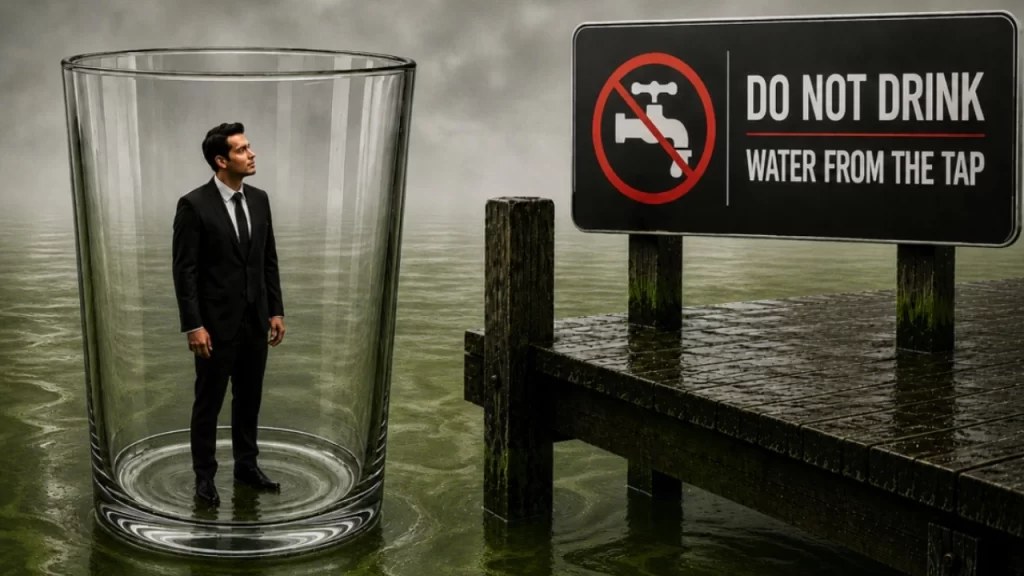
Water is only secure when it can be renewed for potable use
Water reuse is a necessary response to scarcity. It is not, by itself, a water-security strategy.
Reuse simply asks whether water can serve another beneficial purpose. Water security asks whether the managed cycle can repeatedly restore water for safe, reliable, affordable potable production.
That is the difference between reusable water and Renewable Water: one is a strategy for efficiency; the other is a strategy for water security.
Reclaimed water can support irrigation, industry, cooling, construction, landscape maintenance, environmental flows, and aquifer recharge. EPA defines water reuse as reclaiming water from different sources, treating it, and using it again for beneficial purposes.[1]
Those benefits do not secure the drinking-water function that matters most. If reuse expands while source waters become more eutrophic, cyanobacteria-prone, variable, and costly to treat, the system is becoming less – not more – secure.
The decisive question is whether water is being renewed for potable production across the full managed cycle.
|
Reuse question
|
Water-security question
|
|---|---|
|
Can this water be used again for a beneficial purpose?
|
Can water quality be renewed for reliable potable production?
|
|
How much non-potable demand can be offset?
|
Is the source water becoming more or less treatable for potable use over time?
|
|
Is the project technically feasible today?
|
Does the full system remain resilient across future cycles?
|
|
Is water moving efficiently through the pipes?
|
Is water quality being renewed in natural water infrastructure, or is biological and chemical debt accumulating?
|

Where reuse expands while the environmental buffer deteriorates, apparent efficiency will conceal rising biological and chemical debt. Reuse rates may increase while water security declines, because each cycle leaves the next potable-production cycle harder, costlier, and less reliable.
Potable reuse makes the central question unavoidable: can the system continue producing drinking water that is safe, affordable, publicly acceptable, and resilient under changing conditions?
Potable reuse makes this question explicit. EPA distinguishes
Direct potable reuse may be technically achievable and, in some places, necessary. It is also the more demanding institutional pathway: it makes the wastewater-to-drinking-water connection immediate, requires advanced treatment and redundancy, and depends on intensive monitoring, regulatory confidence, and sustained public trust.[3]
Indirect potable reuse can provide residence time, dilution, monitoring opportunity, ecological processing, operational flexibility, and public confidence. But the environmental buffer performs those functions only when it is healthy enough to renew water.
If the buffer is eutrophic, oxygen-stressed, cyanobacteria-dominated, ammonia-impacted, or rich in organic matter and disinfection-by-product precursors, indirect potable reuse becomes a weak reassurance. The water has passed through the environment, but the environment has not renewed it.
Biological and chemical debt is already accumulating in rivers, dams, lakes, reservoirs, and impoundments through eutrophication, hypoxia, harmful algal blooms, cyanotoxins, ammonia, organic matter, internal nutrient cycling, and disinfection-by-product risk.
EPA notes that harmful algal blooms can contaminate drinking water and cause illness, and identifies cyanotoxins such as microcystins and cylindrospermopsin as hazards requiring active management in affected supplies.[4] [5]
These risks reach the treatment plant. As source water becomes less stable, coagulant and oxidant demand rise, filter runs shorten, sludge production increases, and cyanotoxin, ammonia, taste-and-odor, and disinfection-by-product risks become harder to manage.[6]
If each cycle makes the next potable-production cycle more chemical-intensive, costly, or uncertain, water is not being renewed. It is accumulating debt.
Salem, Oregon shows the cost of that debt. After cyanotoxin concerns affected its drinking-water system in 2018, the city invested in ozone treatment and related improvements—reported at $48 million by 2022 and more than $80 million by 2024.[7] [8]
Salem is not an argument against advanced treatment. It shows that degraded source-water biology can become a treatment-cost, monitoring, governance, public-confidence, and resilience problem that many communities cannot readily afford.
Water security is often discussed in terms of storage, transfers, supply augmentation, and demand reduction. All matter, but water can be physically present and still fall outside the treatment envelope needed for potable supply.
Delhi -January 2024
Delhi’s recurring ammonia problem illustrates the point. In January 2024, high ammonical nitrogen in the Yamuna forced the Wazirabad plant to halve production: ammonia reached 5.9 ppm against a treatment capability of about 1 ppm. The same report documented chlorine demand far beyond installed capacity at higher ammonia levels.[9]
A 2025 analysis likewise found ammonia above acceptable limits at the Wazirabad intake, while 2026 reporting described a full shutdown at Wazirabad and major reductions at other Delhi plants during a further high-ammonia event.[10] [11]
The issue is not whether water exists in the system. It is whether it remains within the biological and chemical boundaries that allow reliable, affordable potable production.
Water molecules persist. The question is whether water quality remains recoverable for the purpose society cannot do without.
Renewable Water is water that can be repeatedly restored to a condition suitable for potable production without accumulating biological and chemical debt.
This definition joins built and natural infrastructure. Treatment, monitoring, and process controls remain essential, but their performance depends on what happens upstream in catchments, wastewater systems, rivers, dams, reservoirs, nutrient cycles, oxygen regimes, and food webs.
Renewable Water combines engineering, applied biology, and risk-aware management to preserve the conditions needed for the next potable-production cycle.
It means maintaining the integrity of the managed water cycle – the infinity loop.

Water supply is more secure when both quantity and quality can be maintained within the managed resource base. It is less secure when it depends on emergency transfers, crisis trucking, contested allocations, or ever-more intensive treatment because its own water bodies have become unreliable.
This matters wherever treated wastewater returns to rivers, dams, or reservoirs that later contribute to drinking-water supply. South Africa’s Water Research Commission notes that indirect potable reuse is already common where treated wastewater is discharged to river systems and abstracted downstream.[12]
In Gauteng, the issue is not abstract. The South African Human Rights Commission reported pollution of the Hennops River, Roodeplaat Dam, and other freshwater bodies by untreated and partially treated sewage and sludge; wider research has warned that eutrophication and cyanotoxin risk threaten the usability of freshwater resources across the country.[13] [14]
Indirect potable reuse becomes water security only when the receiving water body is managed as water-renewal infrastructure. Discharging treated wastewater into a river or dam does not create a secure reuse system if that water body is becoming eutrophic, toxic, oxygen-stressed, or microbiologically unsafe.
Non-potable reuse remains valuable. It can reduce unnecessary potable demand and help communities use water more intelligently, but it is a bridge—not the destination.
Bridge
Offsets demand for parks, industry, construction, cooling, and landscaping.
DESTINATION
Restores the conditions required for repeated potable production.
Projects serving parks, industry, construction, cooling, and landscaping can be worthwhile. But they do not resolve the core problem if the reservoir supplying drinking water is becoming more eutrophic, cyanobacteria-prone, variable, or costly to treat.
Renewable Water changes the trajectory by asking whether the managed cycle is restoring the conditions required for repeated potable production.
It means treating rivers, lakes, dams, and aquatic food webs as water-security infrastructure – not scenery around it.
Regions still building their water systems can avoid the old pattern of use, discharge, degradation, and escalating treatment. They can manage built and natural infrastructure together from the start.
For water leaders, the practical test is clear: can reused water ultimately return to potable production; is the environmental buffer strengthening or overloading; and are biological risks being treated as managed water-security risks rather than peripheral environmental concerns?
Reuse, circularity, and integrated water resource management have moved water strategy beyond waste and toward resource recovery. Non-potable reuse can improve efficiency, and direct potable reuse has a role where conditions require it.
But water security requires more. Reuse, “one water,” and circularity are meaningful only when they help maintain a managed cycle in which water can be repeatedly restored for potable production.
The real test is not whether water can be used again, but whether it can be renewed without accumulating the debt that makes future drinking-water production less secure.
That is the difference between water reuse and Renewable Water: one asks whether water can serve another purpose; the other asks whether it can be restored, again and again, for the purpose that matters most—safe, reliable drinking water.
But before asking what capability can achieve it, we need to confront a more immediate question: whether the interventions now used to manage eutrophication are moving a water body toward that standard or away from it.
Algaecides, herbicides, phosphorus precipitants, aeration systems, and dredging are often presented as practical answers to degraded water. The next article examines the harder reality: when these treatments suppress symptoms without restoring biological function, they can deepen the debt that makes Renewable Water harder to achieve.
Many interventions used against eutrophication produce a visible result. Algaecides kill algae. Herbicides kill weeds. Aeration raises average dissolved oxygen. Phosphorus precipitants bind phosphorus. Dredging removes sediment.

Join us. The future of water is biological.
© Sustainable Infrastructure Solutions