
West Chester, PA Brisbane, QLD
The Conclusion The New Agenda
From symptom management to Renewable Water

From symptom management to Renewable Water
The evidence is well documented. FutureLakes’ review of lake-restoration practice finds that treatments focused on symptoms tend to require repeated application because they do not address underlying causes.[1] GAO has shown that harmful algal blooms and hypoxia remain persistent national risks, despite decades of research, response, and coordination.[2] AWWA now recognizes both the strategic importance of source-water protection and the unpriced liability of increasingly hard-to-treat water.[3]
These are not disconnected concerns. They are five expressions of one system failure: water is being managed as if it moves through pipes, plants, permits, and projects in isolation from the living systems that determine whether it remains renewable.
The New Agenda begins with five propositions that explain the present trajectory, predict what follows if it continues, and define the conditions a credible response must meet.
Taken together, the axioms rule out the old operating model. Water security cannot be managed only once water is “in the pipes” of manmade infrastructure alone. Manmade water infrastructure depends on rivers, lakes, reservoirs, wetlands, microbial communities, and food webs that supply water and renew its quality.
They rule out the planning blind spot. A source-water risk that is documented, worsening, and fundamental to treatment performance can no longer be treated as an external uncertainty or somebody else’s environmental problem. It belongs in capital planning, risk management, and infrastructure decision-making.
They rule out the belief that secondary reuse alone can deliver sustainable security. Reuse improves efficiency; it does not guarantee that the next potable-production cycle will remain safe, affordable, or reliable. They also rule out the belief that a short-term improvement in surface appearance proves recovery. A treatment that deepens biological debt is not restoration, even if a selected metric temporarily improves.
Finally, they rule out observation without delivery. Monitoring, research, and reporting remain essential, but they cannot substitute for the ability to diagnose biological failure, design root-cause interventions, and verify that a water body is genuinely recovering.
The New Agenda does not reject engineering, treatment, reuse, monitoring, or regulation. It places each inside a more complete water-security model: one in which natural water infrastructure is treated as a strategic asset, source-water trajectory is managed as a planning variable, and Renewable Water is the standard against which outcomes are judged.
That model requires four linked disciplines.
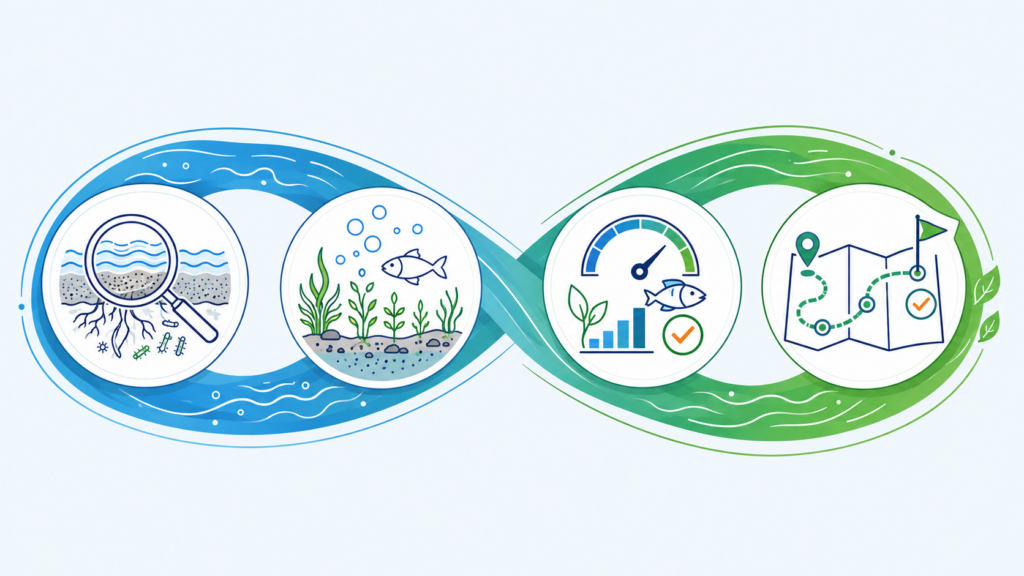
biological condition must be assessed at the level of root causes, not surface symptoms.
interventions must be selected for their capacity to restore the oxygen, sediment, nutrient, and food-web functions that allow water bodies to sustain the Renewable Water paradigm themselves.
performance must be tracked against biological recovery criteria, so cosmetic visual improvement can be distinguished from real recovery.
each water body, catchment, or region needs a Roadmap that turns the shared standard into an accountable plan of action.
The scale of the plan can vary. A Roadmap may begin with a single lake or reservoir, extend across a watershed that includes wastewater works, rivers, dams, and reservoirs, or underpin a regional or national strategy. The principle is the same at every scale: local recovery and system-wide water security must reinforce one another.
The practical pathway is developed in the Road to Renewable Water: a Renewable Water standard, applied biology to restore natural function, biological risk and performance management to verify progress, and Roadmaps that translate the framework into action.
The purpose of the New Agenda is not to make water management more complicated. It is to restore the missing half of the system. When built and natural infrastructure are managed as one, water does not merely move through a linear sequence of abstraction, use, treatment, and discharge. It re-enters a functioning renewal cycle: the natural infinity loop that makes Renewable Water possible.
That is the destination. The Road to Renewable Water begins with the decision to manage for it.

Join us. The future of water is biological.
© Sustainable Infrastructure Solutions